Results
DiffEngine.run() and DiffEngine.run_from_configs() return a DiffResult. It holds a summary of what differs on summary, and the rows behind it on added, removed, and changed, so a notebook can inspect the drift without writing files.
The summary prints as a plain-text report, and one call isolates the rows where a single column disagrees:
import polars as pl

from veridelta import DiffConfig, DiffEngine

diff = DiffConfig(primary_keys=["trip_id"])
source_df = pl.scan_parquet("legacy_trips.parquet")
target_df = pl.scan_parquet("modern_trips.parquet")
result = DiffEngine(diff, source_df, target_df).run()

print(result.summary.report_summary)

# The rows where one column disagreed, with both values side by side.
result.get_mismatches("total_amount")

# The changed rows as a pandas DataFrame, if pandas is installed.
result.to_pandas()
Summary
summary is a DiffSummary, a Pydantic model without any frames. summary.model_dump_json() returns the same JSON that veridelta run --json prints:
| Field | Description |
|---|---|
total_rows_source |
Rows in the source. |
total_rows_target |
Rows in the target. |
added_count |
Rows only in the target. |
removed_count |
Rows only in the source. |
changed_count |
Rows in both with at least one compared value that differs. |
column_mismatches |
For each column with at least one mismatch, the changed rows where it differs. |
total_mismatches |
Added, removed, and changed rows together. |
mismatch_ratio |
total_mismatches over total_rows_source. |
match_rate_percentage |
One minus mismatch_ratio, as a percentage rounded to two places. |
is_match |
Whether mismatch_ratio is at most threshold. |
accepted_count |
Rows of drift a baseline accepted, which the counts above leave out. 0 without one. |
is_perfect_match |
Whether nothing differs. |
volume_shift |
total_rows_target minus total_rows_source. |
report_summary |
A plain-text report of these counts and the most drifting columns. |
schema/run.schema.json is the JSON Schema of this object, and veridelta schema run prints it; see Printing the schema.
Rows
added holds the rows found only in the target, and removed the rows found only in the source. changed holds the rows found in both with at least one difference. Each changed row carries its primary keys and, for every compared column, {column}_source, {column}_target, and {column}_is_match.
get_mismatches(column) returns the primary keys and both values for the rows where that column differs. It raises ConfigError for a column that was not compared. to_pandas() converts changed to pandas; it needs pandas and pyarrow, which Veridelta does not install.
Pushdown results
Pushdown compares in place and never selects values, so its frames hold primary keys only and the result sets keys_only. get_mismatches then returns every changed key instead of one column's values, and still rejects a column that was not compared.
A run with pushdown_sample_rows set also carries changed_sample: up to that many changed rows with each compared column's values, laid out like a local run's changed. See Row samples.
HTML report
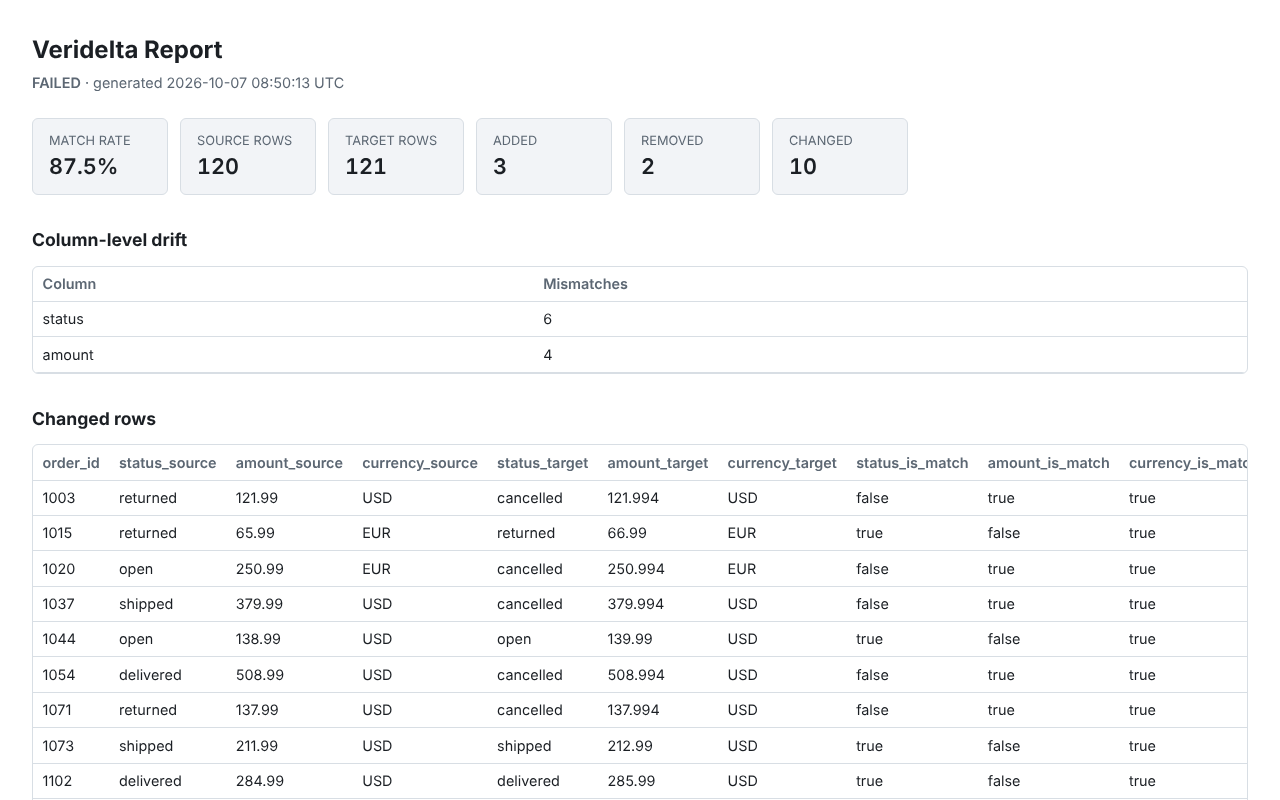
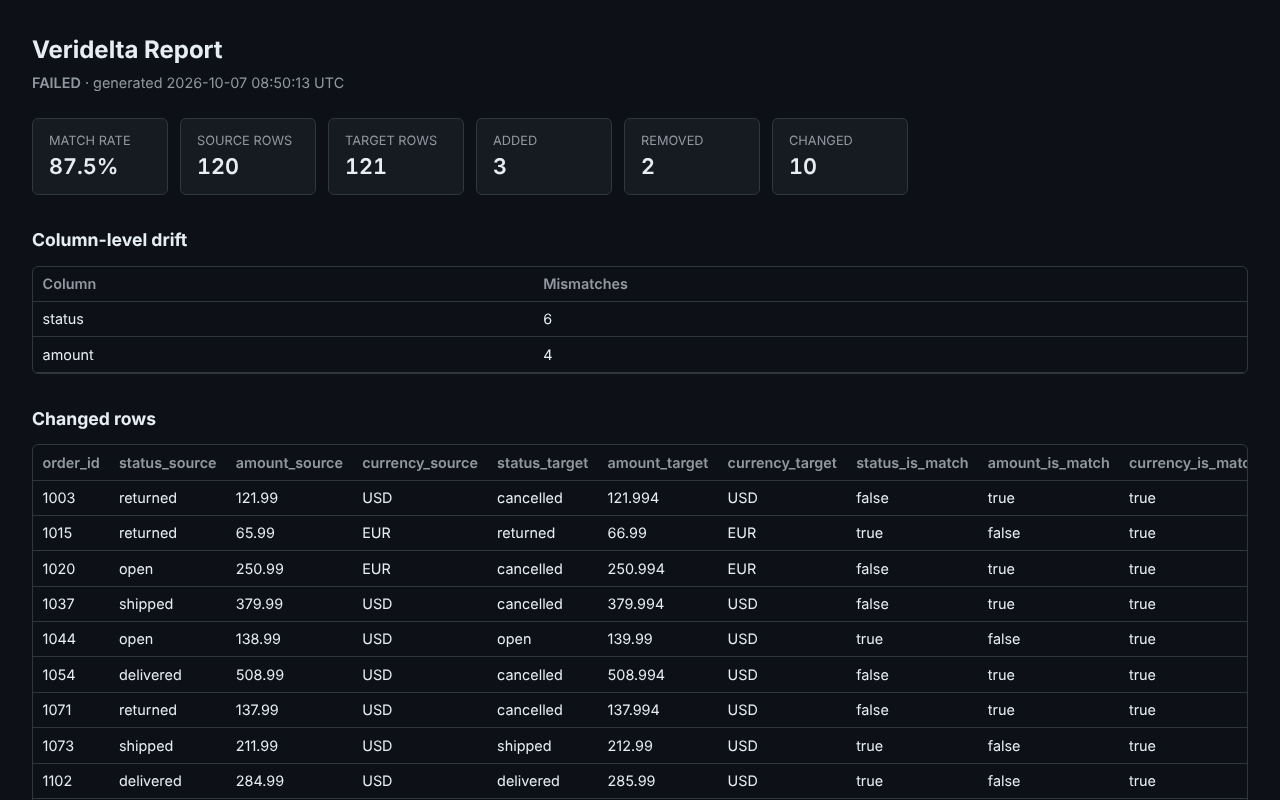
write_html writes the standalone report that veridelta run writes with --html. It embeds its own styles and script, so it opens offline. Every row is in the page itself, and the script splits long tables into pages of 25 rows. max_rows caps every table, as --html-max-rows does:
from veridelta.report import write_html, write_markdown

write_html(result, "reports/nightly.html", max_rows=1000)
write_markdown(result, "reports/summary.md")
Markdown summary
write_markdown writes the short summary that CI posts to a job summary or a pull request, and render_markdown returns it as text. It holds the verdict, a table of counts, and the drifting columns, up to report_top_columns_limit. Column names are written as code, so a name from the data cannot break the table or the page it lands on.
The summary ends with the same counts as JSON, inside an HTML comment that GitHub and GitLab hide from readers. Its first line names the run schema the JSON follows:
<!-- veridelta-summary https://veridelta.github.io/veridelta/schema/run.schema.json
{"total_rows_source":3,"total_rows_target":3,"added_count":1,"removed_count":1,"changed_count":1,"column_mismatches":{"status":1},"is_match":false,...}
-->
The JSON is what veridelta run --json prints, except that column_mismatches holds only the columns the drift table lists, and is left out when report_top_columns_limit is 0. A column name's <, >, and & are written as the JSON escapes \u003c, \u003e, and \u0026, so a name cannot close the comment, and a JSON parser reads them back as the same name. A script, or an agent that reads a pull request comment through the API, parses the line after the marker:
import json
import re

found = re.search(r"^<!-- veridelta-summary \S+\n(.+)$", body, re.MULTILINE)
summary = json.loads(found.group(1))
The summary lists no values unless asked. With max_rows above 0, or --markdown-max-rows on the command line, a "Changed values" table follows the drift table. It has one row per differing value: the primary keys, the column, and the source and target values, lowest keys first. From Python:
Each value is written as code. Text is quoted, so a trailing space or an empty string shows, and NULL reads as null. A value longer than 60 characters is cut and ends in .... The table stops at max_rows values, or before the summary, its JSON comment included, reaches 60,000 bytes, which keeps a pull request comment under GitHub's limit. A last line then says how many values it showed. A pushdown run lists the values of its row sample, so it needs pushdown_sample_rows too.
CI posts the summary where more people may read it than may read the data. Ask for values only where every reader of the job summary and the pull request may see them.
OpenTelemetry metrics
veridelta run --otel otel-metrics.json writes the run's metrics to a file, and --otel-send sends them to an OTLP/HTTP endpoint. Either reaches an observability backend, such as Datadog or Grafana, through an OpenTelemetry Collector or the backend's own OTLP intake. Neither needs an OpenTelemetry package. From Python:
from veridelta import DiffEngine, load_config
from veridelta.telemetry import send_otlp_metrics, write_otlp_metrics

diff, source, target = load_config("veridelta.yaml")
result = DiffEngine.run_from_configs(diff, source, target)
write_otlp_metrics(
    result, "reports/otel-metrics.json", config_path="veridelta.yaml", source=source, target=target
)
send_otlp_metrics(result, config_path="veridelta.yaml", source=source, target=target)
Every metric is a gauge stamped with the time of the run's export, so each run adds one point to each series:
| Metric | Unit | Attributes | Value |
|---|---|---|---|
veridelta.dataset.rows |
{row} |
veridelta.side: source or target |
Rows in each dataset. |
veridelta.diff.rows |
{row} |
veridelta.diff.kind: added, removed, or changed |
Rows only in the target, only in the source, or in both with a value that differs. |
veridelta.column.mismatched_rows |
{row} |
veridelta.column.name |
Changed rows whose value in that column differs. Every compared column reports, so a column that stops drifting reads 0 instead of disappearing. |
veridelta.diff.mismatch_ratio |
1 |
Added, removed, and changed rows over the source rows, as mismatch_ratio is. |
|
veridelta.diff.match |
1 when the run matched within threshold, 0 when it drifted. It has no unit, since a backend such as Prometheus reads a unit of 1 as a ratio. |
Resource attributes say which comparison ran:
service.name, which isverideltaunless the environment renames it, andservice.version;veridelta.config.path, the configuration file;veridelta.source.typeandveridelta.target.type, such asfileorsnowflake;veridelta.source.nameandveridelta.target.name: the table, or the file or lakehouse path.
A URL keeps only its scheme, host, and path, so a token in its user part or a signature in its query never leaves the run. An Azure abfss://container@account path keeps its container, which sits where a user would. A database query source has no name.
Like the Markdown summary by default, the export holds counts and column names, never row values, connection URIs, credentials, or SQL. A run that fails before it has a result writes no file and sends nothing.
The file is one line of JSON in OTLP's JSON encoding, as the OpenTelemetry file exporter format specifies. The Collector's OTLP JSON file receiver, in its contrib distribution, can read it. The same line is the body --otel-send posts.
Sending to an endpoint
--otel-send posts the export to an OTLP/HTTP endpoint, such as a Collector or a vendor's OTLP intake. The standard OpenTelemetry variables configure it:
| Variable | Default | Meaning |
|---|---|---|
OTEL_EXPORTER_OTLP_ENDPOINT |
http://localhost:4318 |
Base URL. /v1/metrics is added to its path. |
OTEL_EXPORTER_OTLP_METRICS_ENDPOINT |
Full URL, used as written in place of the base URL. | |
OTEL_EXPORTER_OTLP_HEADERS |
Request headers, such as an API key, as comma-separated key=value items. |
|
OTEL_EXPORTER_OTLP_TIMEOUT |
10000 |
Milliseconds to wait for the endpoint. |
OTEL_EXPORTER_OTLP_PROTOCOL |
http/json |
The protocol. Only http/json is supported. |
HEADERS, TIMEOUT, and PROTOCOL also have a metrics form, such as OTEL_EXPORTER_OTLP_METRICS_HEADERS. The metrics form wins over the general one, as it does in the OpenTelemetry SDKs.
Header keys and values are percent-encoded, as in OTEL_RESOURCE_ATTRIBUTES, so Bearer <token> is written Bearer%20<token>. No header value appears in a log line or an error, and neither does the endpoint's query. The send follows no redirect, so a header never reaches a second host. Over HTTPS, the endpoint's certificate is checked against the system's trust store.
The send is one attempt, with no retry. When it fails, such as on an unreachable endpoint, an HTTP error, or the timeout, the run exits 3 after writing its files. Under --json, stdout then holds the error object instead of the summary. An unusable variable, or a protocol other than http/json, fails the run the same way before anything is sent.
--otel and --otel-send together write and send the same export.
Attributes from the environment
The standard OpenTelemetry variables add resource attributes, so a run can carry its environment or its team:
OTEL_RESOURCE_ATTRIBUTESholds comma-separatedkey=valueitems, such asdeployment.environment=prod,team=data. Percent-encode a comma, an equals sign, or a percent sign inside a key or value.OTEL_SERVICE_NAMEreplacesservice.name. It wins over aservice.nameinOTEL_RESOURCE_ATTRIBUTES, as the OpenTelemetry specification requires.
When the environment sets a key that Veridelta also sets, Veridelta's value wins, except for service.name. The instrumentation scope stays veridelta. The values are exported as written, so keep secrets out of them.
A malformed OTEL_RESOURCE_ATTRIBUTES, such as an item without = or a % that starts no valid escape, is ignored whole, as the specification recommends. The veridelta.telemetry logger then warns without repeating the value. On the command line, --verbose prints that warning. Without it, the variable is dropped silently.
Artifacts
With output_path set, a run writes the differing rows to that directory as added_rows, removed_rows, and changed_rows, in the output_format. An empty set writes no file. Pushdown writes primary keys only, under other names; see Differences from a local run.
output_format is parquet (the default), csv, json, ndjson, or arrow. CSV and JSON have no type for bytes, so csv, json, and ndjson write a binary column, such as a MySQL BIT, as hexadecimal text, and refuse a column that nests binary values in a list or a struct. Excel is not offered, because writing a workbook needs a second dependency that a discrepancy file does not justify. Neither is Avro: the Polars writer cannot store several types a discrepancy frame can hold, such as Int8, unsigned integers, nanosecond or timezone-aware timestamps, and all-NULL columns.